I. In Consequence of the Demolition of Haggerston Castle, Beal, Northumberland: Illustrated Catalogue of the Most Expensive and Best Period Style Fixtures and Fittings, Metal, Materials and Fabric; Also Garden Ornaments, Balustrading, Paving, Sculptured Stone Figures, Fine Wrought Iron Gates, Etc. Etc. II. Haggerston Castle, Beal, Northumberland: Catalogue of Four Days Sale. III. llustrated Particulars of Sale with Plans and Conditions of Sale of the Valuable Freehold Sporting, Manorial, Residential Estate, known as Haggerston Castle, covering in all about 1750 Acres, Etc. Etc. [45871]

Illustrated Particulars of Sale with Plans and Conditions of Sale of the Valuable Freehold Sporting, Manorial, Residential Estate, known as Haggerston Castle
On Saturday, the 3rd of May, 1930, C. D. Leyland attempted to sell his late father C. N. Leyland’s estate at auction, entrusting the sale to Ward Price & Co. The firm issued a small folio catalog describing the property in detail, including Haggerston Castle, a 150-room Italianate mansion replete with Georgian and Adams fireplaces and other desirable amenities.
The sale, unfortunately, was not a success.
[click to continue…]
Tagged as:
adams,
auction,
country house,
georgian,
haggerston
(Designs by Joseph Urban.) Progress in Industrial Color and Protection at “A Century of Progress.” Chicago (American Asphalt Paint Co.) 1933. [45366]
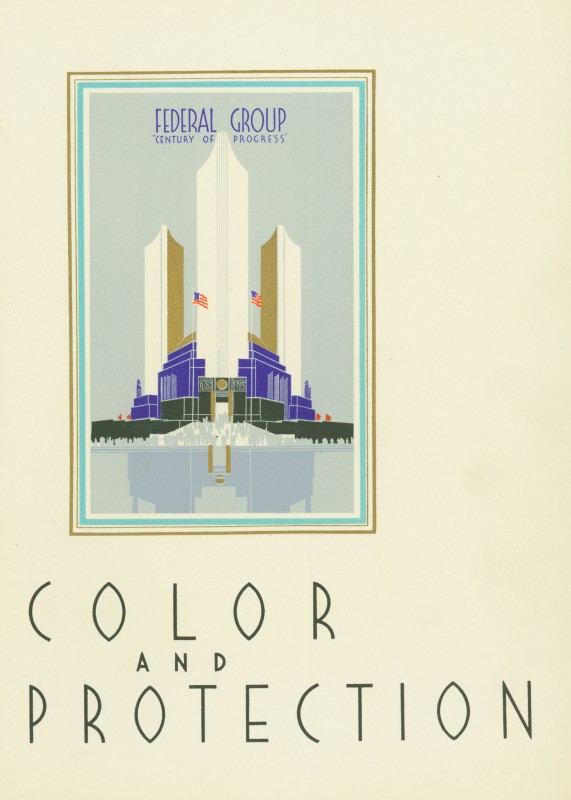
Color and Protection (front cover).
Celebrated architect, interior decorator, exhibition designer, illustrator and color theorist Joseph Urban (1872-1933) went out on a high note. His final project, a commission to oversee an inventive color scheme for The Rainbow City exhibits of the 1933 Chicago World’s Fair, drew on the full range of his talents and interests. [click to continue…]
Tagged as:
1933 Chicago World's Fair,
A Century of Progress,
American Asphalt Paint Co.,
Color Theory,
Exposition Design,
Joseph Urban,
The Rainbow City
FOUR LETTERS FROM PROMINENT CHICAGO ARCHITECTS IN RESPONSE TO A QUERY BY A YOUNG MAN. 4 letters, 3 in typescript and one in manuscript in pen, from: 1) Howard J. White of the firm Graham, Anderson, Probst & White (one page); 2) Chas Morgan (two pages); 3) Ernest N. Braucher (one page); and 4) Clarence W. Doll (two pages). [
45797]
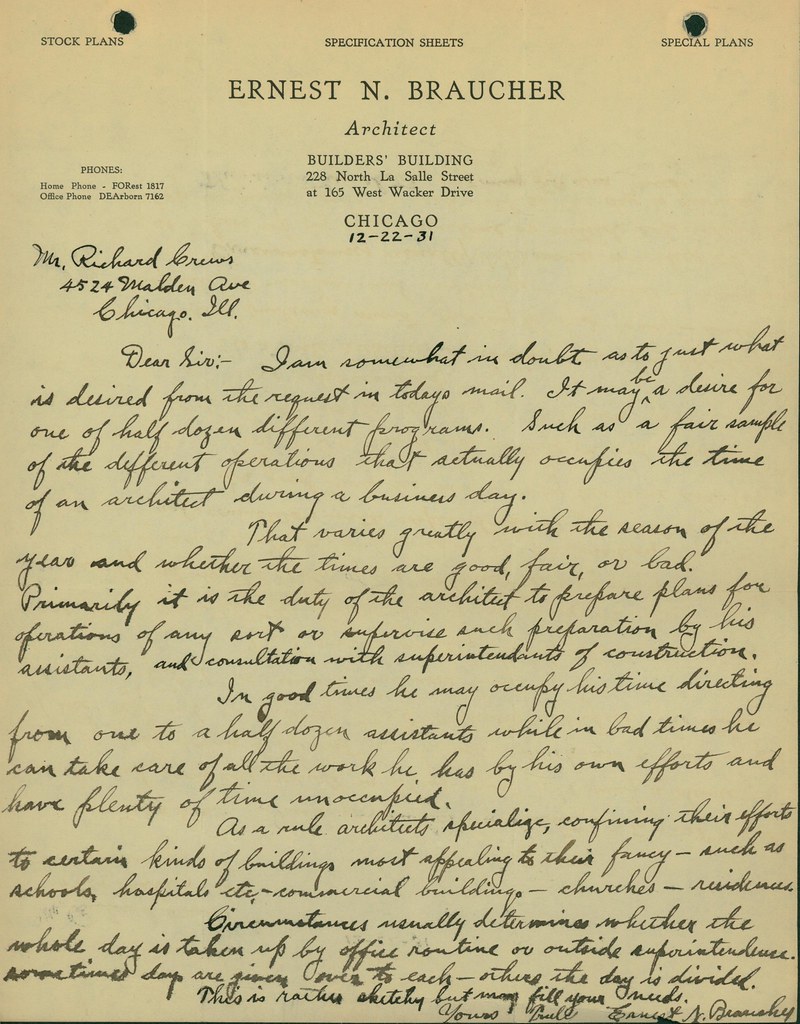
Letter from Ernest N. Braucher
On December 21, 1931, a young man named Richard Crews sent letters to the offices of several prominent Chicago architects inquiring about the demands of daily life in the profession. He received well-considered, carefully written, and quite informative responses from at least four members of the trade: Howard White, a founding member of one of Chicago’s most renowned firms, Graham, Anderson, Probst & White (successors to D. H. Burnham & Co.); Chas Morgan, an active associate of Frank Lloyd Wright (who, indeed, signed his letter “Charles Morgan, Chicago Associate of Frank Lloyd Wright”) and draftsman for Wright’s unrealized but ambitious National Life Insurance Building; Ernest Braucher, who designed scores of Craftsman-style residences in Chicago, several of which are currently marked for historic preservation; and Clarence Doll. [click to continue…]
Tagged as:
Architecture,
Chicago,
Frank Lloyd Wright,
Great Depression,
letters


